Homes on The Battery
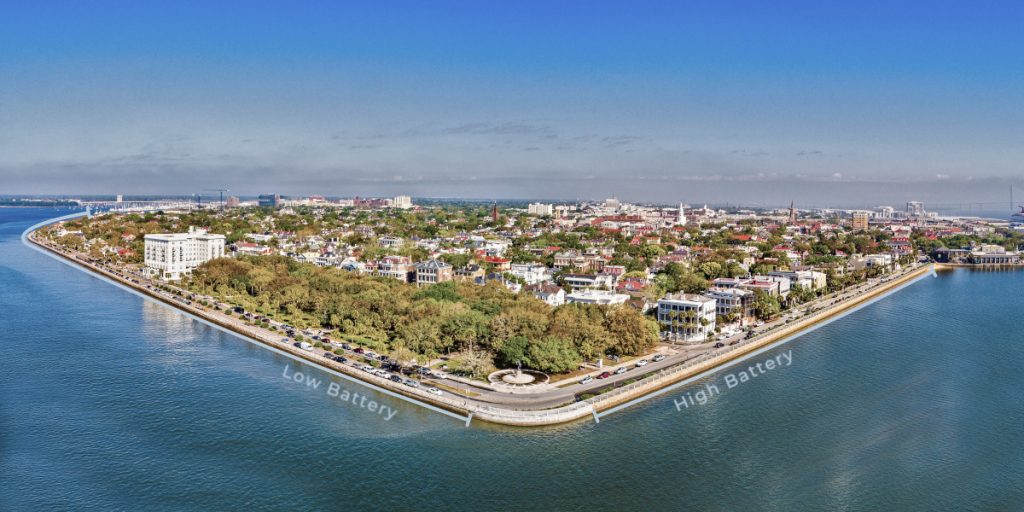
Charleston’s Battery is often treated as one continuous waterfront address. From a distance it sort of is, though from a homeowner’s perspective it is better understood as three distinct residential settings: the High Battery along East Battery Street, the homes facing White Point Garden, and the Low Battery along Murray Boulevard.
Each shares the same South of Broad waterfront, but they were not created at the same time or in the same way. The development history shows up in the architecture, lot patterns, views, public activity, and the practical questions that matter when evaluating an individual property.
Explore the Battery
The Battery reads as one continuous seawall around the southern edge of the peninsula, but the homes behind it belong to three different residential settings. The High Battery and the White Point Garden edge are largely part of Charleston’s older South of Broad fabric; Murray Boulevard is the major twentieth-century break, created when the city built a new western seawall and reclaimed land from the Ashley River.
East Battery and South Battery contain buildings from several periods, often altered more than once. Murray Boulevard is distinctly later overall, but even there the street continued to develop well beyond its first construction wave.
The High Battery
Layered historic fabric · Direct harbor relationship · Very high public exposure
Explore this section
White Point Garden
Historic housing · Park foreground · Very high public exposure
Explore this section
The Low Battery
Later housing · Western light · Lower tourist intensity, substantial road traffic
Explore this section
High Battery

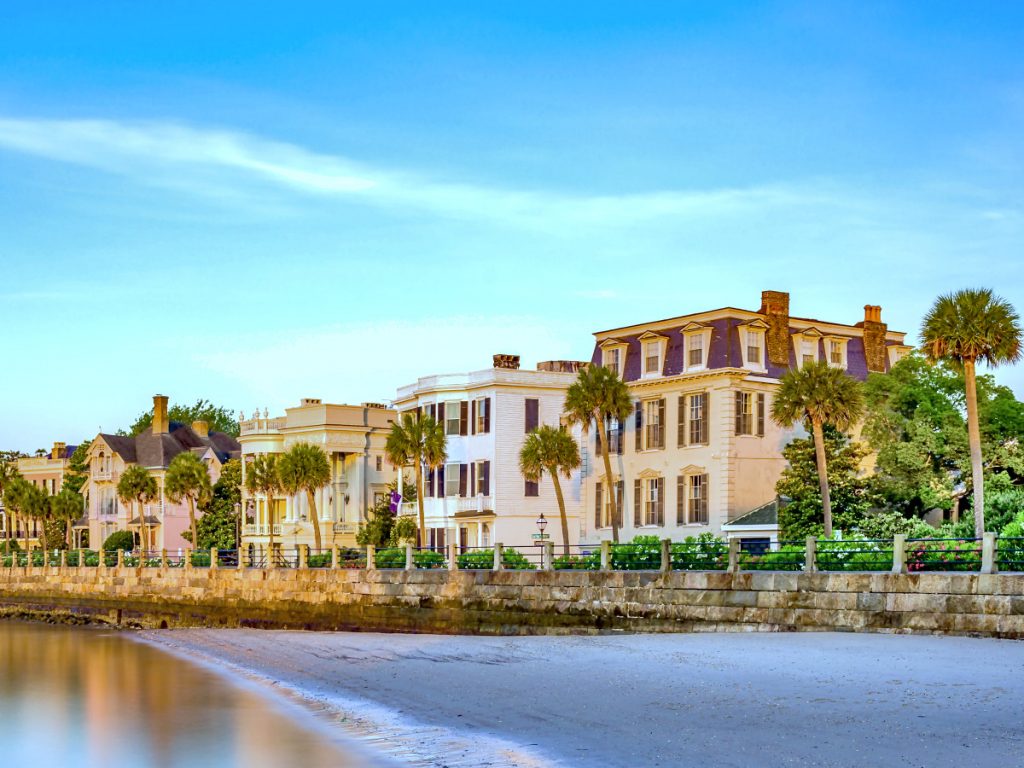
The High Battery is the stretch most people picture when they hear “homes on The Battery.” East Battery Street runs directly behind the raised promenade, with broad views across Charleston Harbor toward Fort Sumter, Sullivan’s Island, and the Cooper River shipping channel.
Most of the defining residences are nineteenth-century, but the row is not one antebellum moment preserved intact. Houses have been raised, enlarged, repaired after storms and the 1886 earthquake, restyled, subdivided, restored, and occasionally replaced. That layered history is part of what makes East Battery visually coherent without making the individual buildings architecturally uniform.
A streetscape built in layers
Greek Revival is the most obvious recurring language, but it is only part of the street. Regency and late-Federal work, Italianate details, late-nineteenth-century Eastlake design, and early-twentieth-century revival architecture all appear along a short stretch of waterfront. The Charleston Single House form appears within that broader fabric, but it does not explain the street on its own. The Edmondston-Alston House at 21 East Battery makes the layering especially clear: built in the Regency style in 1828, it was remodeled a decade later with Greek Revival features while retaining earlier interior character.
For a buyer, the build date is therefore only the first line of the story. Piazzas, dependencies, rear wings, enclosed porches, foundations, roofs, windows, and mechanical systems may belong to different campaigns.
The public realm is equally important. East Battery is one of the most visited streets on the peninsula. Pedestrians, carriage tours, sightseeing vehicles, photographers, and ordinary local traffic move through the same narrow edge that functions as the front yard of some of Charleston’s most prominent residences. The harbor relationship is exceptional, but reclusive privacy should not be considered an option.
When comparing South of Broad homes, I look for chronology as much as condition: floor elevation, prior water intrusion, structural movement, masonry repairs, window campaigns, piazza work, roof configuration, mechanical placement, parking, and the practicality of bringing modern systems through historic fabric. A prestigious address does not repeal the laws of building science, and preservation rules mean that some seemingly simple exterior changes involve a lot more public officials than you might expect.
Homes on the High Battery


White Point Garden

White Point Garden changes the foreground more than it changes the age of the surrounding neighborhood. The houses along South Battery are largely a continuation of the older South of Broad fabric, but instead of facing the seawall directly they open onto lawn, paths, mature live oaks, and one of Charleston’s most important public spaces.
The chronology is broad. Surviving houses facing the park include eighteenth-century fabric, major antebellum construction, and substantial late-nineteenth-century work. There is no single “White Point Garden architectural era.” What unifies the streetscape is the park itself: deep shade, long sightlines through trees, formal gardens and walls, and a layered view in which the harbor is secondary to the canopy.
South of Broad, framed by the park
The park edge contains a wider mix than a quick glance suggests: eighteenth-century masonry houses altered in the nineteenth century, Greek Revival and Italianate work, Queen Anne, and later Beaux Arts, Renaissance Revival, and other Victorian-era changes. At 20 South Battery, a circa-1843 house was substantially transformed in 1870 with a bracketed cornice and mansard roof. The present façade tells more than one story because the building itself does.
That is the practical value of the architectural labels – they help identify likely construction campaigns, but they should not be mistaken for a complete diagnosis. A piazza, roofline, dependency, garden wall, or interior plan may have changed long after the original house was built.
South Battery remains a prime route for pedestrians and carriage tours, and the park is used throughout the day by walkers, runners, families, tour groups, photographers, events, and locals. The trees soften the setting; they do not make it private.
For a buyer, exact position matters. A house near East Battery experiences the park and harbor differently from one farther west. Tree canopy can improve shade while filtering water views; corner exposure can add light and access while increasing visibility. Parking, driveways, garden depth, dependencies, first-floor elevation, and the chronology of prior alterations deserve property-specific attention.
Homes facing White Point Garden

Fort Sumter House at 1 King Street
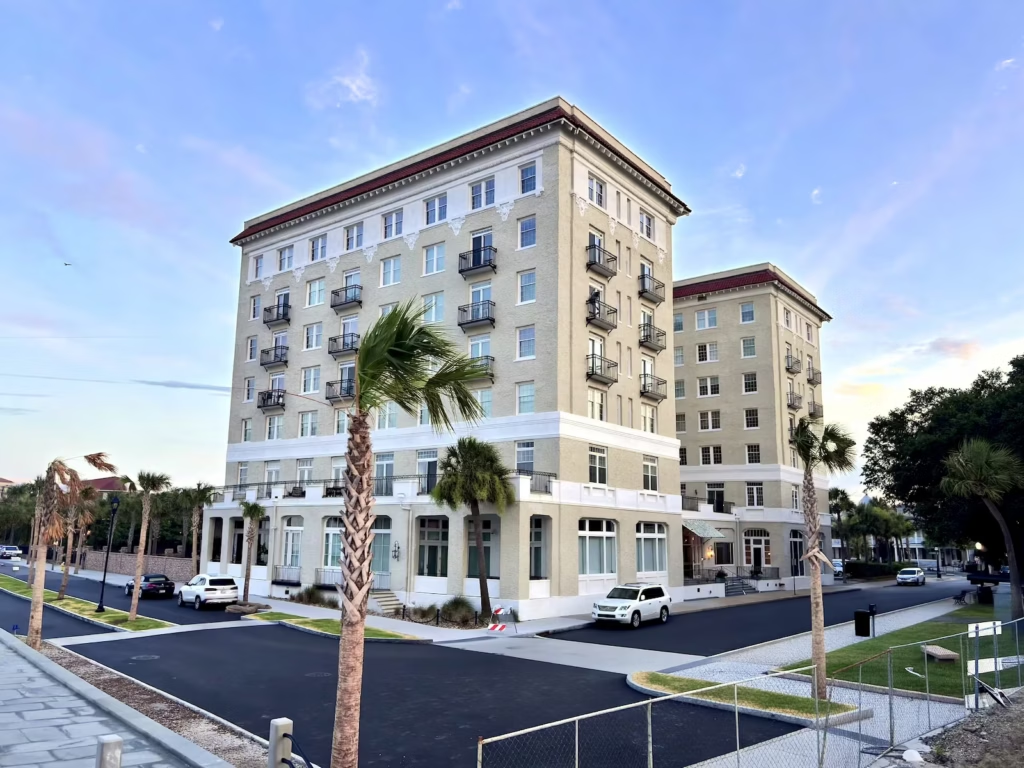
Fort Sumter House at the southern end of King Street very conspicuously predates Charleston’s well-known height limits. It opened as Fort Sumter Hotel in 1924, designed by Atlanta architect G. Lloyd Preacher in a Spanish Colonial Revival vocabulary with Mediterranean influences. Its height and modern hotel program were striking enough to worry Charleston’s early preservation advocates (a few years before the BAR was established).
The hotel was purchased for redevelopment in 1973 and its 225 rooms were converted into 67 condominiums. For a buyer on the Battery, Fort Sumter House changes the real estate questions almost completely: instead of evaluating a private garden, dependency, crawlspace, and generations of house additions, a buyer is comparing unit position and view orientation alongside association finances, reserves, assessments, common systems, master insurance, parking, and building maintenance. Inventory can be sporadic, and two units in the same building can have different exterior views and ownership costs.


Low Battery

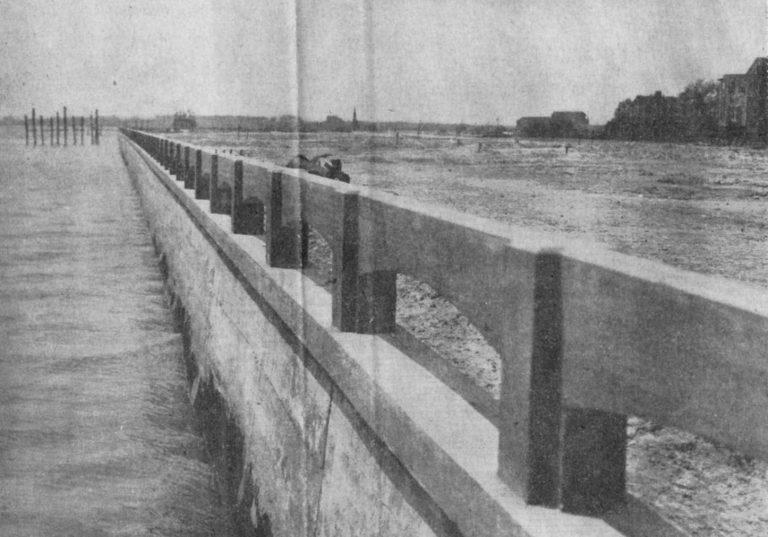
Murray Boulevard is the major chronological break in the story of the Battery. Much of the land behind it did not exist in its present form until Charleston built a new western seawall and filled marsh and riverbed in the early twentieth century. The first Boulevard Project work ran from 1909 to 1911, with an eastern extension completed later in the 1910s.
The strongest early residential wave came in the 1910s through the 1930s, when substantial architect-designed houses rose along the new waterfront. These were modern houses for their time, but many were deliberately informed by established architectural precedents in Charleston.
New land, old architectural vocabulary
Colonial Revival and Neoclassical Revival provide much of the early street’s visual language – with Georgian, Federal, Charleston, and more eclectic historical references appearing from house to house. The C. Bissell Jenkins House at 52 Murray, completed in 1913, is a particularly clear high-style Colonial Revival example, while nearby early houses range from Neoclassical porticoes to more unusual Jacobean and late-Queen Anne influences. The common thread is revivalism, not uniformity.
The newly created land also allowed many lots to accommodate broader footprints, driveways, garages, and twentieth-century service patterns more readily than the narrow older peninsula parcels. Murray Boulevard did not stop building in the 1930s, either: mid-century, later replacement, and contemporary construction share the street with the first generation of houses. A 1914 revival house and a recent house may have the same view while presenting entirely different systems and renovation questions.
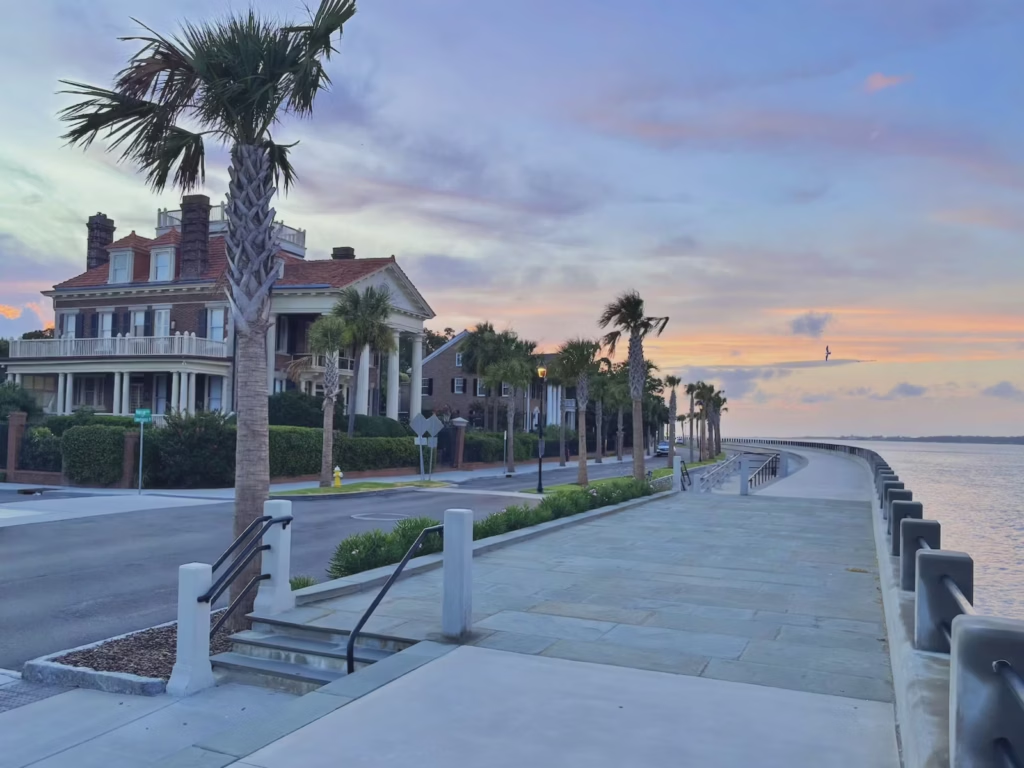
The Low Battery faces the Ashley River rather than directly into Charleston Harbor. Its western orientation brings broad water views, strong afternoon light, and photogenic sunsets, together with direct sun, wind, salt exposure, and weather from across the river.
The waterfront itself is now quite different from the one many longtime Charlestonians remember. The Low Battery reconstruction rebuilt the wall, raised much of its elevation, widened the promenade, and upgraded drainage, crossings, utilities, and accessibility. For some houses, the higher wall changes first-floor sightlines, though upper floors retain expansive views. The seawall is modern infrastructure, though it is not a parcel-level guarantee against stormwater intrusion.
Murray Boulevard has much less tourist and carriage-tour activity than East or South Battery, but it is not a quiet lane. Vehicle through-traffic is substantial, and the seawall attracts steady local pedestrian and bicycle use. For a buyer, the questions are very specific: when was this house built, what has happened to it since, and how does its floor elevation, systems, insurance profile, and view relate to the rebuilt Low Battery.
Homes on Murray Boulevard


Buying on the Battery
I once represented buyers purchasing a home on Murray Boulevard, and that transaction reinforced something that is easy to miss when looking at Battery properties from the outside: the address may be immediately recognizable, but the important questions belong to the individual building.
Inspect the house that actually exists. We hired an inspector with deep experience in historic Charleston buildings. He identified substantial structural movement that warranted additional evaluation and materially changed the economics of the deal. That information gave us something useful to negotiate, especially from the perspective of a professional who had seen the hidden bits of many neighboring structures.
Put water decisions ahead of comfort upgrades. I advised the buyers not to place vulnerable HVAC equipment or insulation in the crawlspace until the water intrusion path was understood and addressed. That decision paid off when Hurricane Matthew rolled through just months later.
Future public work belongs in today’s evaluation. At the time, the Low Battery reconstruction was still in the proposal stages. I attended the city planning meetings to keep the buyer informed before and after closing, because it was important that they accept the realities of a major infrastructure undertaking upfront. That project is now complete, and the exercise remains a good example of why awareness of future changes belongs in a buyer’s property analysis before it becomes the view out the window.
Test the daily setting. We spent time in South of Broad at different hours to understand traffic, tourism, parking, pedestrian activity, and the odd reality of living in front of a backdrop people come to photograph. A golden-hour sunset showing is a great selling point, but it does not tell you what the street feels like on a busy Saturday afternoon.
Then there is the transaction and the work after closing. Documented findings can change negotiations, and renovation expectations need to account for the Board of Architectural Review before a buyer mentally redesigns the exterior. Financing an older historic property can be dramatically improved by working with a local lender familiar with these properties. The lesson I kept from that transaction is simple: approach historic Charleston properties as individual buildings first and prestigious addresses second.
Due Diligence
A waterfront view can consume most of a first showing. I am usually looking in the other direction as well: at the building, the ground beneath it, what has changed, and how the property actually functions.
The building
The water
The rules
The street
During a showing, I am looking beyond the view long enough to understand the building: what is original, what changed, where water goes, how the public realm behaves, and what future work would actually require. That is where the famous address becomes a functioning property.
How Charleston built this waterfront
The High Battery grew from earlier seawall and fill work along the harbor; White Point Garden became a civic landscape through later public improvements; and the Boulevard Project pushed Charleston’s western edge into the Ashley River to create Murray Boulevard. The rebuilt Low Battery continues the same pattern: a waterfront that appears timeless has repeatedly been engineered.
Sources & further reading
- Jonathan H. Poston, The Buildings of Charleston: A Guide to the City’s Architecture, for individual property chronology and architectural context.
- Charleston County Public Library / Charleston Time Machine for seawall, fill, and Boulevard Project history.
- City of Charleston preservation records and Low Battery reconstruction documentation for current public-work context.
Three settings, property by property
There is no universally preferable section of the Battery. The High Battery puts layered older buildings directly against Charleston Harbor and the city’s most visible waterfront promenade. White Point Garden brings an equally historic residential edge into a deep park landscape. Murray Boulevard is the twentieth-century counterpart, with revival-era and later houses facing west across the Ashley River from infilled land.