Short-Term Rentals in Charleston
Short-term rental potential in Charleston is not a feature that every property simply has. It depends on the governing jurisdiction, zoning, permit structure, neighborhood context, and the way the property would actually operate.
Demand matters, though the first task is determining whether the intended use is legal, practical, and durable enough to justify the investment.

The First Question Isn't Revenue
One of the easiest mistakes is to begin with revenue projections. A more durable analysis works in the opposite direction: first confirm that the intended use is legally possible, physically practical, and resilient enough to survive changing costs and rules. Only then does the financial analysis become meaningful.
Legal first. Operations second. Revenue third.
A prospective short-term rental must clear all three gates. Passing one does not compensate for failing another, and the order matters: legality establishes the opportunity, operations test the property, and the numbers determine whether the risk is worth taking.
Can You Operate It?
Before considering occupancy rates or nightly pricing, identify the governing jurisdiction, zoning, permit category, ownership requirements, and any annual limits or permit caps. If the intended use is not permitted, nothing else matters.
Can the Property Support It?
Parking, bedroom layout, guest circulation, private entrances, association restrictions, insurance requirements, and neighborhood context all affect whether a property can function successfully as a short-term rental—even when regulations technically allow it.
Does It Still Make Sense?
Revenue projections only become useful after the legal and physical questions have been answered. At that point the analysis shifts to operating costs, seasonality, financing, maintenance, management, future regulation, and eventual resale.
A cautionary lesson: disappointing short-term rental purchases rarely fail because the nightly rate was a bit optimistic – they fail because the buyer assumed the property could operate as intended before confirming that it actually could.
Starting Point
The listings below are useful because they turn the guide’s framework into a practical exercise. For each property, begin with the same questions: who governs it, what use is permitted, whether the building can support that use, and whether the ownership plan still makes sense after the optimistic assumptions are removed.
These are active listings, not endorsements. The listing here does not establish short-term rental eligibility, permit availability, profitability, or suitability for a particular buyer. Regulations, private restrictions, property conditions, and listing status can all change.


Do not begin with the projected nightly rate. First establish whether the use is legal, whether the property can support it, and whether the purchase still makes sense under a less favorable operating model.
When a Listing Becomes a Property
Public listings can show price, location, photographs, and the features entered into the MLS. They cannot confirm which authority governs the parcel, whether a permit is available, how private restrictions are written, or whether the property will operate as expected after insurance, management, maintenance, and seasonal demand are considered.
For represented buyer clients, I review those questions together before treating a listing as a viable short-term rental opportunity.
Rules & Stipulations
“Charleston” may describe the broader region, a mailing address, a county, or the City of Charleston itself. Those are not interchangeable. Short-term rental rules are written and administered by individual municipalities, counties, zoning authorities, and sometimes private associations.
The first regulatory question is therefore not, “Are short-term rentals allowed in Charleston?” It is, “Which authority governs this particular parcel?”
Geography Comes Before Regulation
Community names, ZIP codes, and mailing addresses do not reliably reveal which government regulates a property. The map should be used as regional orientation – not as a parcel-level zoning determination.
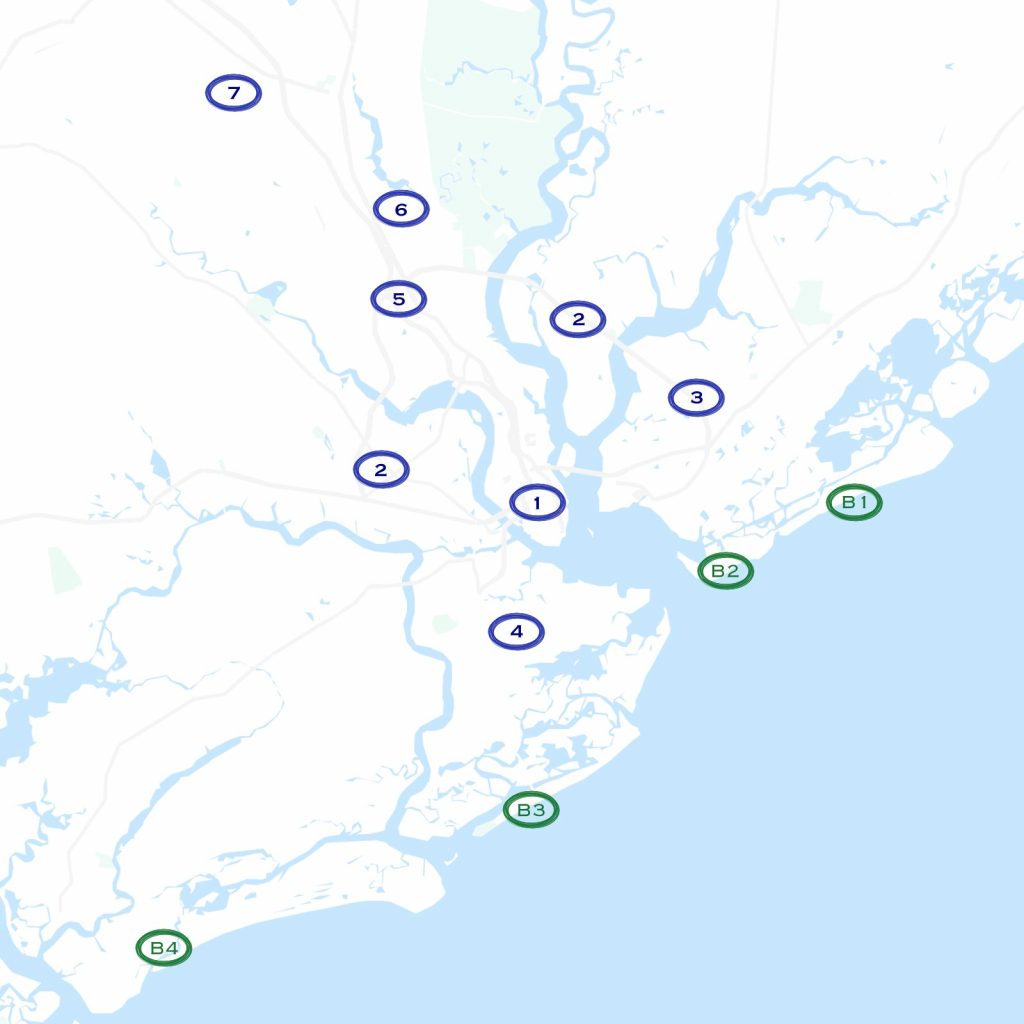
The peninsula is a regulatory environment in and of itself.
The City of Charleston regulates short-term rentals through location- and property-based permit categories. Building type, zoning type, owner occupancy, parking, and the number of rental units can all affect which path – if any – is available.
That makes the city address only the beginning of the analysis. The parcel and the applicable permit category still have to be verified.
Crossing a municipal boundary can change the rules entirely.
Mount Pleasant, North Charleston, Hanahan, Goose Creek, Summerville, and other municipalities establish and administer their own local rules. Similar-looking homes in neighboring communities – even on the same street – may face different permit procedures, ownership requirements, operating limits, or enforcement practices.
MLS results tend to flatten those boundaries, but the application of rules is precise.
Visitor demand may be regional; island regulations are local.
Charleston’s beach and island communities share a tourism economy, but they do not share one short-term rental system. Municipal rules, resort governance, permit limits, business requirements, and private association restrictions can differ sharply from one island or development to the next.
A successful rental history under one owner should not be assumed to establish the same right for a buyer.
Sometimes "none of the above" has its own set of rules.
Parts of West Ashley, James Island, Johns Island, and other broadly named areas can include municipal and unincorporated territory. Two nearby properties may fall under different zoning ordinances and different short-term rental procedures.
Unincorporated Charleston County maintains its own short-term rental classifications and zoning requirements, separate from those of the City of Charleston and other municipalities.
Identify the authority before evaluating the opportunity
Confirm the parcel
Identify the rules
Test the plan
This is where a regional guide reaches its limit. Two properties a mile apart – or across the street from one another – can fall under different rules, support different operating models, and carry very different levels of risk.
Time & a Place
Charleston’s visitor economy depends on places for people to stay. Hotels, inns, resorts, and many short-term rentals all contribute to that ecosystem, and in the right setting they can strengthen both tourism and the local economy.
Problems usually arise when every property is viewed through the same lens. A condominium designed around visitors, a historic inn district, and a quiet residential street may all appear together in an online search, even though they serve very different purposes.
Over the years I’ve found that the healthiest outcomes tend to occur when the property’s design, the surrounding neighborhood, and the governing regulations all point in the same direction. When those three elements align, owners, neighbors, guests, and the community generally benefit together.
I don’t think the conversation is really about short-term rentals – rather I think it’s about compatibility.
Some places are designed to welcome visitors. Others exist primarily as neighborhoods where people expect a quieter, more permanent pattern of life.
Most of the difficult debates begin when those two expectations overlap.
Frequently Asked Questions
These answers provide a regional framework for evaluating a potential short-term rental. Property-specific eligibility still depends on the parcel, governing authority, permit category, private restrictions, and the buyer’s intended operating model.
Can a short-term rental permit transfer with the property?
Do not assume so. Permit transferability depends on the governing jurisdiction and the permit category. A property’s current rental use, advertising history, or existing permit does not by itself establish that a buyer can continue the same operation after closing.
Does strong visitor demand mean a property can operate as a short-term rental?
No. Demand and legality are separate questions. Zoning, permit rules, ownership requirements, private restrictions, and the property’s physical configuration determine whether the intended use is possible.
Is the neighborhood name or ZIP code enough to identify the applicable rules?
No. Community names, ZIP codes, and mailing addresses often cross municipal or county boundaries. The analysis begins with the parcel, its governing authority, and its zoning – not the name used in the listing.
Can an HOA or condominium regime prohibit rentals that local law allows?
Yes. A municipality or county may allow a use while a declaration, master deed, regime rule, deed restriction, or other private covenant prohibits or limits it. Public permission does not override a valid private restriction.
Should revenue projections come before permit research?
No. Revenue analysis becomes useful only after legal eligibility and practical operation have been confirmed. Otherwise, the projection is measuring a business model that may not be available to the buyer.
What property features matter beyond legality?
Parking, bedroom layout, guest circulation, private entrances, occupancy limits, insurance, financing, management, maintenance, and neighborhood context all affect whether a legal short-term rental is also a workable one.
What happens if short-term rental rules change after purchase?
Still have a question? The answers above cover the issues buyers ask most often, but every property presents its own set of circumstances.
Every property deserves its own evaluation.
When representing buyers considering a short-term rental purchase, I evaluate much more than what appears in an MLS listing. Together we review the property’s governing jurisdiction, applicable regulations, physical suitability, ownership objectives, and the practical risks that shape long-term success.
Every buyer has different priorities, and the right answer for one property may not be the right answer for another. The goal isn’t simply to determine whether a property can operate as a short-term rental, but whether it remains the right purchase after the difficult questions have been answered.