Connecting communities
Infrastructure in the Lowcountry is not arranged in a tidy grid. It is a collection of peninsulas, islands, marsh edges, tidal creeks, causeways, and port routes. The bridge network is what makes that geography function most days, and what exposes its limits on the other days.
That is why the crossings below are more than landmarks. They are the region’s operating system, with prettier views and less predictable loading times.
Peninsula ↔ Mount Pleasant
What it explains: regional identity, East Cooper commuting, port clearance, and bicycle/pedestrian access over the Cooper River
Livability implication: Downtown versus Mount Pleasant is also a bridge-timing decision.
Peninsula ↔ West Ashley
What it explains: suburban growth, medical district access, and the long-running gap in safe non-car access
Livability implication: West Ashley is close to downtown, but closeness still depends on the crossing.
Mount Pleasant ↔ Sullivan’s Island
What it explains: island access, evacuation dependency, and the charm/friction of a movable bridge
Livability implication: Island living depends on a small number of routes behaving well under pressure.
West Ashley ↔ James Island
What it explains: drawbridge friction, Folly Beach traffic, and the limits of judging travel by mileage
Livability implication: A short trip can become a civic seminar in boats, timing, and patience.
North Charleston ↔ Daniel Island / East Cooper
What it explains: freight movement, beltway traffic, port logistics, and I-526 dependence
Livability implication: Regional mobility is a system, not a scenic-drive problem.
Mount Pleasant local crossing
What it explains: working waterfront pressure, restaurant traffic, boating, tourism, and neighborhood-scale congestion
Livability implication: Small bridges can carry oversized local consequences.
The crossings that define the Lowcountry
Charleston County’s bridges fall into a few practical categories. Some are symbolic and regional, like the Ravenel. Some are daily hinges, like the Ashley River bridges. Some are island lifelines. Some are freight corridors. Some are modest neighborhood crossings asked to absorb tourism, development, and boat traffic all at once.
Reading them this way is more useful than reading them as a list of structures. The point is not bridge appreciation for its own sake, though the Ben Sawyer does have a certain stubborn charm. The point is to understand how routes shape daily life.
Ravenel Bridge
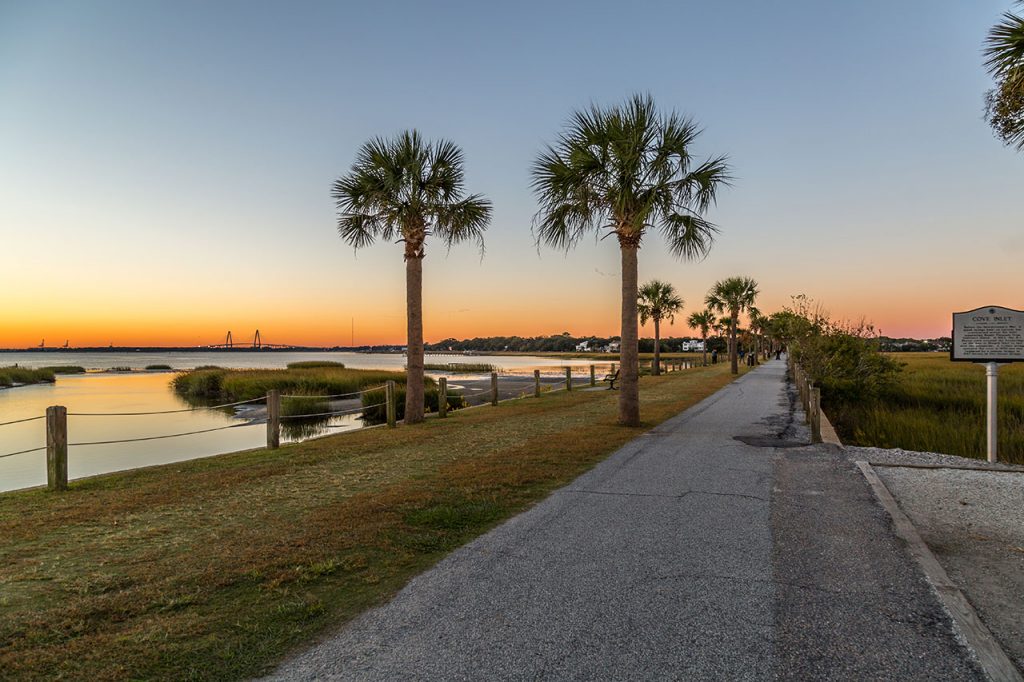
The Arthur Ravenel Jr. Bridge is Charleston’s best-known crossing because it performs two jobs at once. It is the postcard version of the region — cables, towers, harbor, skyline — and it is also a piece of hard-working transportation infrastructure built for commuters, port clearance, and East Cooper growth.
Completed in 2005, the cable-stayed bridge replaced the older Grace Memorial and Silas N. Pearman bridges, two cantilever spans that had become functionally obsolete and temperamentally alarming. The Ravenel gave the region eight traffic lanes, a higher navigational clearance for shipping, and a much better public face than the old bridge pair, which had the emotional range of a dare.
Its best public feature is Wonders’ Way, the separated bicycle and pedestrian path running the length of the bridge. It turns a highway-scale structure into one of Charleston’s best linear overlooks, proving that transportation design can occasionally remember humans exist.
The Ravenel is where regional image, daily commuting, port movement, and recreation overlap. For buyers comparing Downtown Charleston and Mount Pleasant, the bridge is less a line on a map than a recurring access question.

Ashley River Bridges
The Ashley River Memorial Bridge is a pair of drawbridges connecting Downtown Charleston with West Ashley. The first span opened in 1926, helping turn West Ashley from a loosely connected edge of the city into Charleston’s first major suburban expansion.
A second span, the Legare Bridge, followed in 1961 as West Ashley neighborhoods such as Windermere and Ashley Forest grew into full commuter suburbs. The result is a crossing that still carries enormous daily importance, even when its movable mechanics occasionally behave as if trained by a screen door.
The next chapter is the separate Ashley River Crossing, a bicycle and pedestrian bridge intended to connect West Ashley more safely with the peninsula, the medical district, and the existing West Ashley Greenway network. That matters because West Ashley’s greatest advantage — close access to downtown without downtown pricing — has always been partly limited by how safely and comfortably people can cross the river without a car.
It will not make West Ashley “walkable” by magic. No bridge has that wand. But it should make the downtown edge, the medical district, and the Greenway feel more connected for people biking, walking, or using micromobility. That is a real livability change, especially near Avondale, Byrnes Downs, Windermere, and the close-in West Ashley neighborhoods.

The movable bridges explain the bargain
Movable bridges are part infrastructure, part local theater. They preserve marine access and historic waterway function, but they also interrupt road travel when tall vessels need passage. That tradeoff is not a bug in the Lowcountry. It is one of the operating conditions.

Ben Sawyer Bridge
The Ben Sawyer Bridge connects Mount Pleasant with Sullivan’s Island across the Intracoastal Waterway. Opened in 1945, it replaced the older trolley-era access pattern that once tied the island to Mount Pleasant by rail and trestle.
It is a swing bridge, rotating on its central pier for taller boat traffic. The result is scenic, historic, and occasionally inconvenient in the way only useful old machinery can be. Hurricane Hugo made it one of the storm’s most memorable images in 1989; later rehabilitation preserved its familiar profile while replacing major structural and operating systems.

Wappoo Creek Bridge
The Wappoo Creek Bridge connects James Island with West Ashley over Wappoo Creek, part of the Intracoastal Waterway linking the Ashley River with the Stono River. The current double-leaf drawbridge dates to 1956, replacing an earlier swing bridge from the automobile-access era.
Because the bridge is relatively high for a movable span, it opens mainly for taller vessels, usually sailboats. When it does open, the region receives a small civic reminder that boats were here first and do not care about your lunch reservation.
The Don Holt
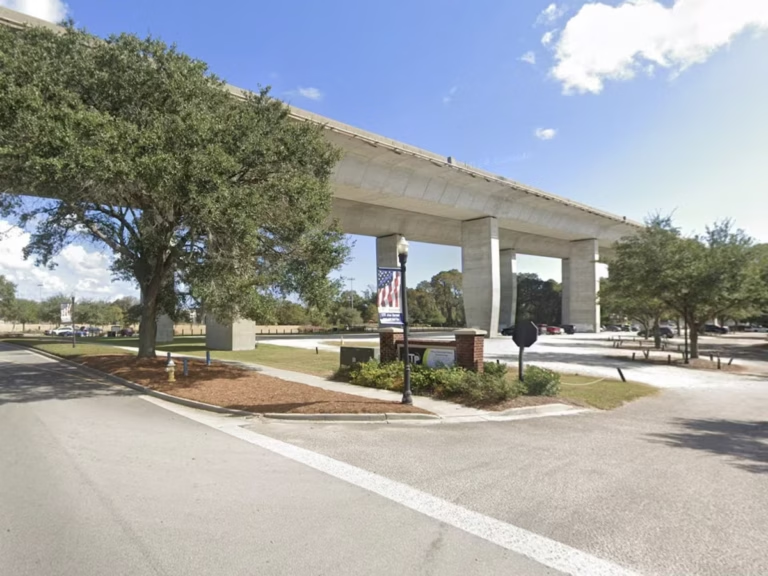
The Don Holt Bridge carries I-526 across the upper Cooper River, connecting North Charleston with the East Cooper side of the region. Built in 1992, it helped make I-526 a practical beltway rather than a collection of hopeful pavement fragments.
Its job is less romantic than the Ravenel’s, but arguably just as consequential. The bridge supports regional freight movement, port access, hurricane evacuation routing, and the everyday connection between North Charleston, Daniel Island, Mount Pleasant, and I-26.
This is the bridge that makes the article stop being scenic and start being honest. Charleston’s livability is not only beaches, porches, and neighborhood character. It is also logistics, interchanges, freight corridors, airport access, and the road network that lets the region function without constantly asking Meeting Street to do unpaid overtime.
The larger I-526 Lowcountry Corridor conversation is about traffic flow, interchange design, widening, ramp improvements, and how the region moves people and goods through North Charleston and toward East Cooper. The Don Holt Bridge sits inside that system, which is why it matters even if it rarely appears in lifestyle photography.

Shem Creek Bridge
The Shem Creek Bridge carries traffic within Mount Pleasant over one of the area’s most recognizable tidal creeks. The current structure replaced an older wooden bridge in 1972, as Mount Pleasant’s growth was shifting from small town to suburban center with a seafood accent.
The bridge is modest compared with the Ravenel or Don Holt, but its setting does plenty of work. Shem Creek remains a working-waterfront landscape, a recreational boating corridor, and a restaurant district, all compressed into a small geography that can become lively, congested, and photogenic in the same breath.
That makes Shem Creek a small-scale version of Charleston’s larger transportation pattern: water access, development pressure, tourism, and daily movement all trying to occupy the same narrow edge.

What bridges mean when choosing where to live
Compare crossings, not just distances
A home can be “ten minutes from downtown” in the same way a boat can be “nearly tied up” while drifting into the marsh. Test the actual crossing and direction you will use.
Look for route redundancy
Some neighborhoods have multiple plausible exits. Others depend on one crossing behaving well. That matters during wrecks, storms, repairs, school traffic, beach weekends, and regular human overconfidence.
Separate scenic value from access reliability
A beautiful bridge view is not the same thing as easy daily movement. The Ravenel can be both magnificent and crowded. Charleston specializes in dual truths.
Watch bridge and corridor projects
Construction can be annoying before it is useful. A new bike/ped bridge, repaired draw span, or redesigned interchange may change how a location feels over the next few years.
Consider non-car access realistically
A bridge may be close, but not safe or comfortable to cross outside a car. The practical question is not whether a route exists. It is whether a normal person would use it without auditioning for a cautionary tale.
Use the route as part of the property
In Charleston County, access is not background information. It is part of the home’s actual livability, whether the MLS field bothers to mention it or not.
Current bridge and corridor projects to watch
Ashley River Crossing
The City of Charleston describes the Ashley River Crossing as a bicycle and pedestrian bridge connecting West Ashley and Downtown Charleston, with related intersection and crossing improvements. Construction began in 2025, with substantial completion expected in 2027.
I-526 Lowcountry Corridor
The WEST project focuses on redesigning how I-526 and I-26 connect, widening I-526 between Paul Cantrell Boulevard and Virginia Avenue, and improving ramps. EAST planning has separately studied the corridor from Virginia Avenue toward US 17 in Mount Pleasant.
Wappoo Creek Bridge
SCDOT has proposed repair, rehabilitation, and preservation work for SC 171 over Wappoo Creek. The stated purpose is to increase safety and extend the service life of the bridge.
The route is part of the property
That is the practical point of looking at bridges this way. They are not just landmarks. They shape commute reliability, neighborhood comparison, beach access, evacuation planning, bike connectivity, and the way Charleston keeps negotiating with water.
For real estate decisions, this matters because livability is rarely just about the home itself. It is about the routes that make the home work. In Charleston County, those routes often begin and end with a bridge.