A Walkable Goose Creek
Nestled above North Charleston is the bedroom community of Goose Creek, a town named for its waterway path.
Goose Creek has neighborhoods, schools, parks, and convenience. What it has historically lacked is the thing many older towns inherited by accident: a recognizable, walkable center.
When this article was first published in 2021, Goose Creek was asking whether a suburban bedroom community could grow something closer to a downtown. Five years later, the answer is more interesting than a rendering and less complete than a ribbon cutting.
I have updated this article to explore what has materialized in the five years since I wrote it: the Red Bank District, a current zoning code with Village Node and Central Creek tools, Central Creek Park, and the Joseph S. Daning Amphitheater.
The civic question is whether zoning, public space, private redevelopment, and political patience can eventually make daily life feel less car-dependent.
Skipping the Center
The origins of today’s Goose Creek can be mostly attributed to nearby military institutions during World War II, after which the G.I. Bill brought an inundation of new residents.
By the 1960s, the town incorporated and began building infrastructure from the mindset of suburban growth: separated uses, wide roads, large residential areas, and shopping centers that asked residents to arrive by car.
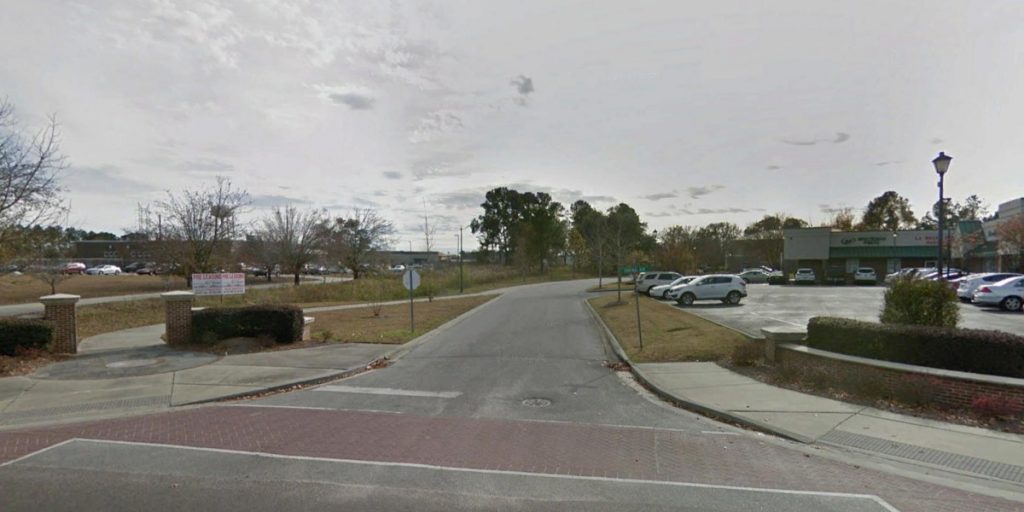
That pattern did produce a lot of real homes for real families. It also left Goose Creek without the sort of center where ordinary errands, civic life, restaurants, and public space gather into something legible. Blocks of strip malls, yes. A downtown, no.
The issue is not that Goose Creek lacks neighborhoods. It is that many daily destinations are separated from those neighborhoods by roads, parking lots, and zoning patterns that make walking feel theoretical.

The 2021 Question
The 2021 Comprehensive Plan did not pretend that one tidy downtown could be dropped onto Goose Creek like a stage set. The plan recognized that the city’s geography and transportation network make a single town center difficult.
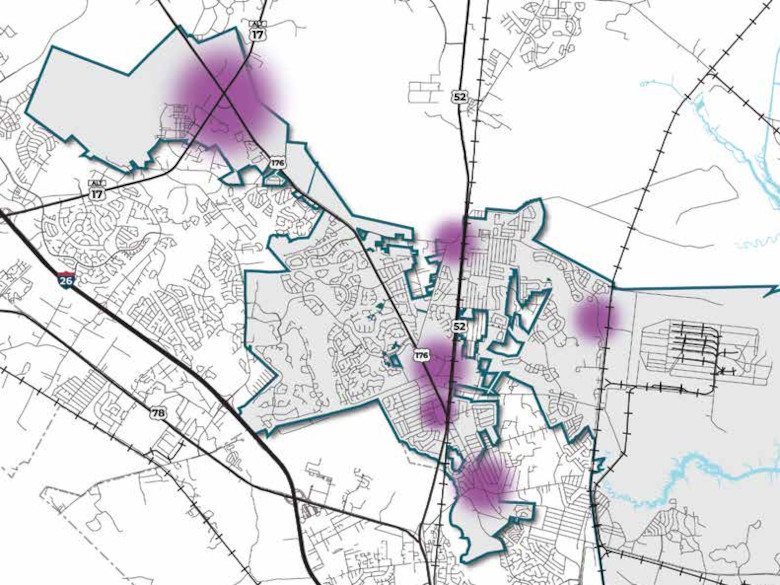
The proposed answer was a network of village nodes: Carnes Crossroads, the Civic Village area, Central Village, a Neighborhood Village node, Liberty Hall, and the Red Bank Road corridor. Each would serve a surrounding area with a mix of uses and a density appropriate to its infrastructure.
The most downtown-like idea was the Central Village Node, located where many residents already identify Goose Creek’s traditional center. The plan imagined living options, offices, shops, restaurants, green space, and a more connected street network. In other words: less parking-lot archaeology, more actual place.
The 2021 plan called these long-term framework ideas, not a construction schedule. Development would depend on market conditions, property ownership, zoning, infrastructure, and the willingness of current owners to redevelop. As land-use caveats go, that one is doing calisthenics.
What Changed Since 2021
The story is no longer just a hopeful plan. Since this article was first written, Goose Creek has added zoning tools, civic amenities, and design standards that make the walkable-center idea more concrete. Concrete, regrettably, still dries slowly.
Red Bank moved from planning concept toward overlay policy
The city began the Red Bank District planning work after the 2021 plan identified Red Bank Road as one of the village nodes needing further study. The resulting overlay is aimed at a pedestrian-oriented, mixed-use, pro-arts/artisan corridor.
Central Creek Park became a civic anchor
Central Creek Park opened as a 13-acre all-abilities recreational space at 147 Old Moncks Corner Road, giving the City Hall area a stronger public-life center than a municipal campus alone could provide.
The zoning code now has the right machinery
The current Chapter 151 zoning framework includes the Village Node District, Red Bank District Overlay, and Central Creek District Overlay. That matters because a plan without zoning is often just a very attractive suggestion.
Central Creek got downtown design standards
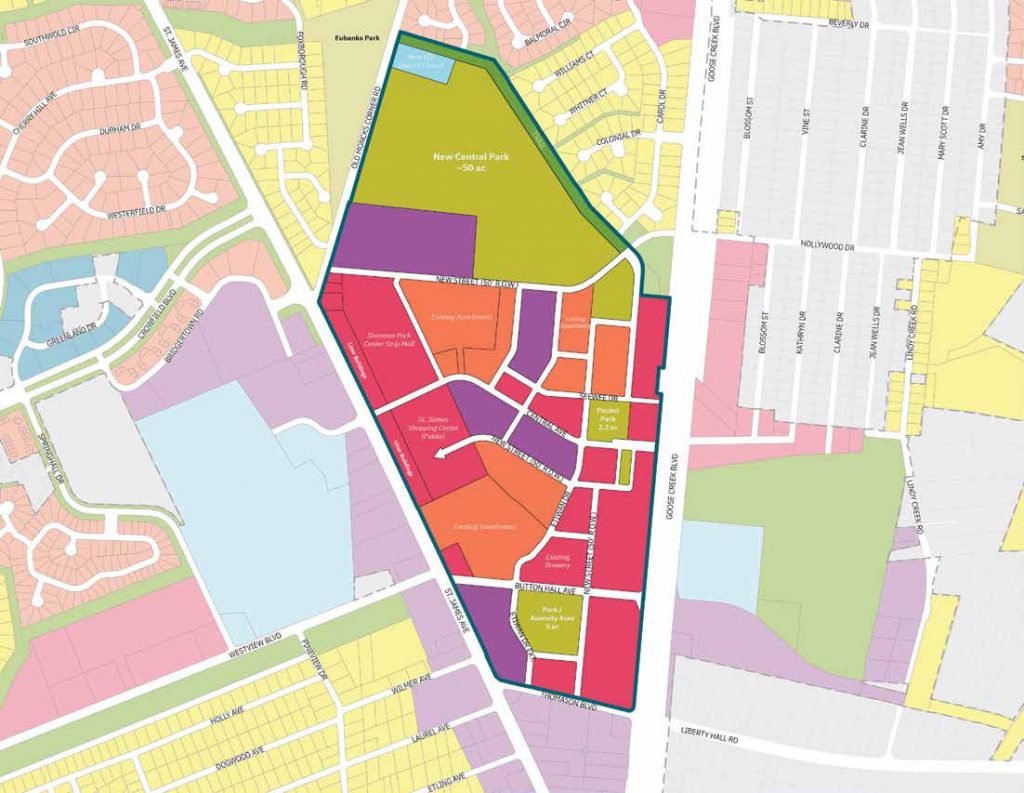
The Central Creek District standards describe a future downtown setting with residential, commercial, and institutional uses, interconnected streets, sidewalks, paths, active frontages, landscaping, and open space.
Events started giving the core a reason to exist
The Daning Amphitheater opened in 2024, and the Central Creek Farmers Market now gives the park recurring public activity. A downtown needs buildings, but it also needs habits.
Central Creek
Central Creek is now the clearer framework for Goose Creek’s town-center ambition. The Central Creek District Design Standards are explicit: the vision is for Goose Creek’s downtown, with a mix of residential, commercial, and institutional uses in a lush, walkable, resilient setting.
That is a meaningful change from 2021. The city now has language requiring development to think about sidewalks, paths, building frontages, entrances, open spaces, landscaping, parking, materials, and the boring little details that decide whether a place feels walkable or merely decorative.
But standards are not storefronts. Central Creek still has to pass through the unglamorous middle stage: parcel ownership, financing, redevelopment thresholds, infrastructure, parking politics, and enough private demand to turn regulatory intent into buildings people actually use.
Central Creek has civic gravity now, but it has not yet become the sort of place where residents can capture a complete center village experience.
Red Bank Corridor
Red Bank is a different test than Central Creek. It is not the civic downtown framework. It is a corridor retrofit: a place where older commercial parcels, shallow lots, international food, small businesses, public art, and residential edges all have to coexist without pretending the road was secretly King Street with better parking.
The city’s stated intent is to transition Red Bank Road into a pedestrian-oriented, mixed-use, pro-arts/artisan, boutique manufacturing corridor compatible with nearby residential development. That is ambitious, but it is also more plausible than asking a suburban corridor to become a postcard overnight.
For Goose Creek, Red Bank may be the proof-of-concept. If it can become safer, more connected, and more locally expressive without simply pushing out the very businesses that make it interesting, the village-node idea gets teeth.
Corridor revitalization can easily become either paint-on-asphalt quick fix – the more useful outcome improves crossings, supports local businesses, and allows small-scale mixed use without sanding off the character that was supposed to be celebrated.

Homes Near the Emerging Core
The real-estate question is not simply whether a home is “in Goose Creek.” Goose Creek is large enough that the city name can hide more than it reveals. A home near Central Creek, Red Bank, or a useful neighborhood route may have a very different daily-life pattern from a home that requires a car for every errand.
Use current listings as examples, not predictions. The point is to compare distance, crossings, sidewalks, bike routes, shade, and what you would realistically walk to on a normal Tuesday.
Current Goose Creek Homes for Sale


Home Buyers
A walkable Goose Creek would not turn the city into Charleston, nor should that be the goal. The useful ambition is simpler: more daily life closer to home, more places worth walking to, and a built environment that gives residents options beyond the car for at least some ordinary trips.
Proximity is not enough
Measure the actual route, not the crow-fly distance. A short drive can still be an ugly walk if the route crosses fast roads, disconnected sidewalks, or parking-lot gaps.
Civic space is different from daily use
A park, amphitheater, or farmers market adds real quality of life. It does not automatically create daily-needs walkability unless shops, services, homes, and safe routes connect to it.
Watch the edges
The best future value may sit near the transition between stable neighborhoods and the emerging Central Creek or Red Bank framework, but only where the route makes sense on foot or bike.
Expect a long timeline
Overlay districts and design standards help future redevelopment behave better. They do not remodel the city by next Thursday, which is inconvenient but apparently legal.