Invasive Plants in the Lowcountry
The Problem Usually Begins with a Plant That Works Too Well
An invasive plant is not simply a plant that grows quickly, spreads enthusiastically, or becomes irritating after a wet summer. The term generally refers to a non-native plant that establishes beyond cultivation and causes measurable harm to natural areas, native plant communities, wildlife habitat, agriculture, or other resources.
That distinction matters because plenty of non-native plants remain where they are planted and cause little trouble. Invasive plants behave differently: they reproduce and move beyond the landscape they were dropped into – through seeds, berries, roots, stems, water, random wildlife, and often through shared landscaping equipment.
The same Lowcountry weather that produces long growing seasons with abundant rainfall also does wonders for noxious weeds. Drainage corridors, wetlands, roadsides, and rapidly changing development sites offer plenty of places for an escaped garden plant to become established. Once it does, the growth can be explosive and can become uncontrollable.
From Garden Plant to Landscape Problem
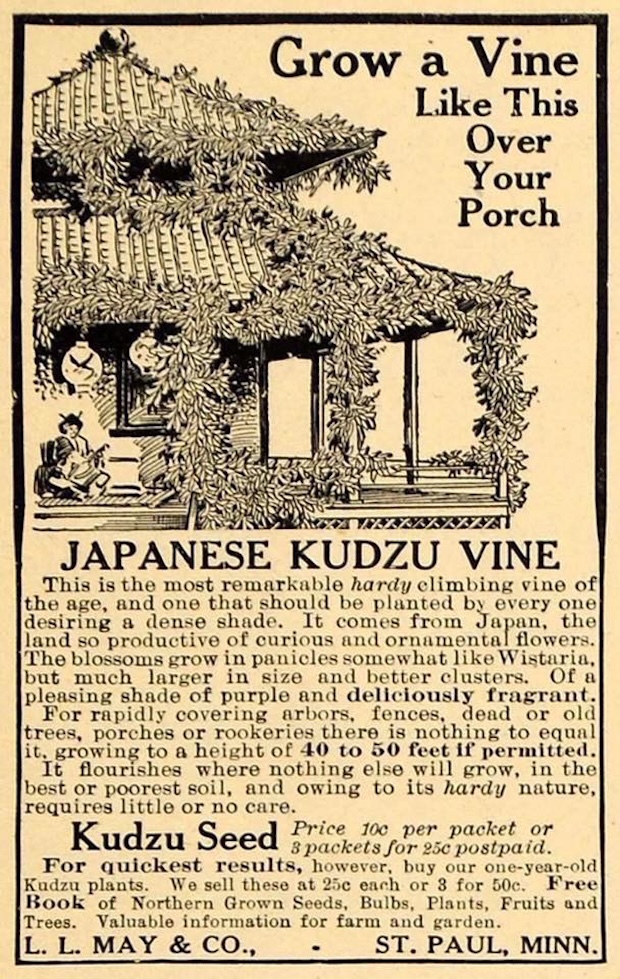
Most invasive plants in the Lowcountry did not arrive as weeds. They arrived as products – sold for flowers, screening, erosion control, rapid growth, or pond decoration. Many worked exactly as advertised.
The problem came later, when seeds, roots, runners, berries, or plant fragments moved beyond the place where someone intended them to stay.
How the Problem Moves Beyond the Yard
Most homeowners did not knowingly create an invasive-plant problem. They inherited a landscape shaped by decades of nursery recommendations, development practices, and gardening trends. Identifying the plants early is usually much easier—and less expensive—than removing them after they have spread across the property.
Vines
Wisteria
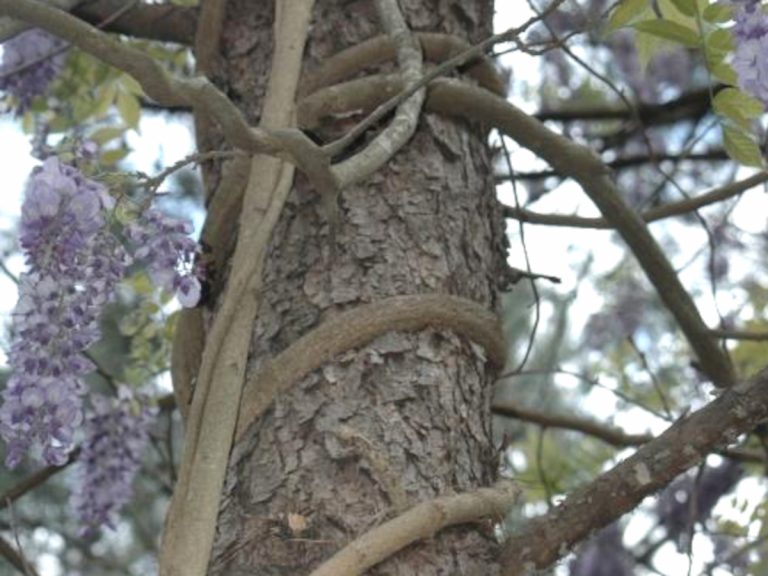
Spring in Charleston brings a exquisite display of wisteria flowers, hanging in dramatic purple clusters sortof like grape bunches. American wisteria is native to the Southeast and is cultivated in many Lowcountry gardens, however two related Asian species, Chinese and Japanese wisteria, were planted even more widely. The Asian wisteria species grow faster, produce larger flower clusters, and bloom earlier. Both have escaped cultivation across South Carolina and now choke established tress along roadsides, woodland edges, and older landscapes.
Once established, the vines climb trees and structures, spread by runners, and form dense growth that shades and girdles surrounding vegetation. Large infestations can persist for years after the visible vines are cut, and mature stems can become heavy enough to damage trees and structures. Their flowers remain attractive. The rest of the arrangement can be a nightmare.
Identification and Management
Chinese and Japanese wisteria generally flower earlier than American wisteria – often in April rather than May – and produce longer, more elongated flower clusters. Their seed pods are fuzzy, while American wisteria produces smooth pods. This is one of the more reliable distinctions after flowering has ended.
Asian wisteria commonly appears along roadsides, forest edges, ditches, rights of way, older fence lines, and around structures where it was planted. Cutting vines can relieve immediate pressure on a tree, but established root systems readily resprout over and over. Complete control usually requires repeated follow-up and may warrant professional assistance where vines are large, intertwined with mature trees, or interfering with buildings.
Property Notes
Kudzu
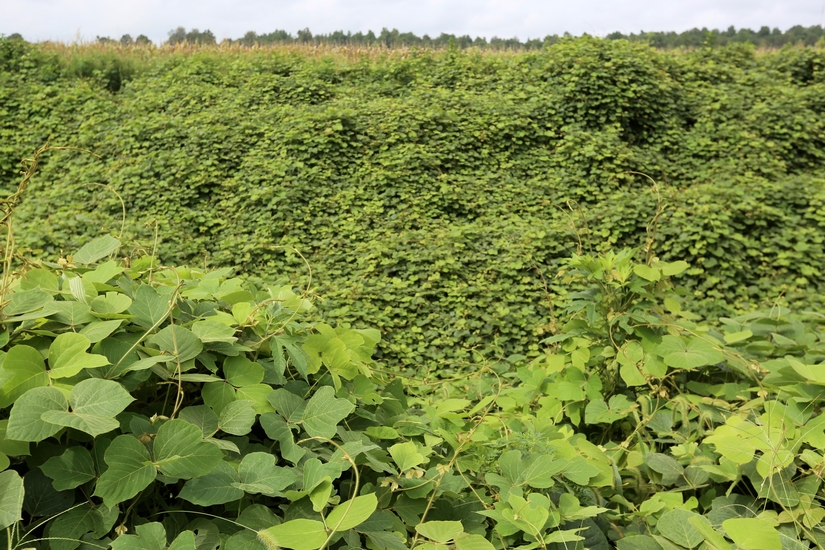
Kudzu was introduced from East Asia and later promoted throughout the South for forage and erosion control. It proved exceptionally well suited to the region’s long growing season, disturbed soils, roadsides, embankments, and open woodland edges.
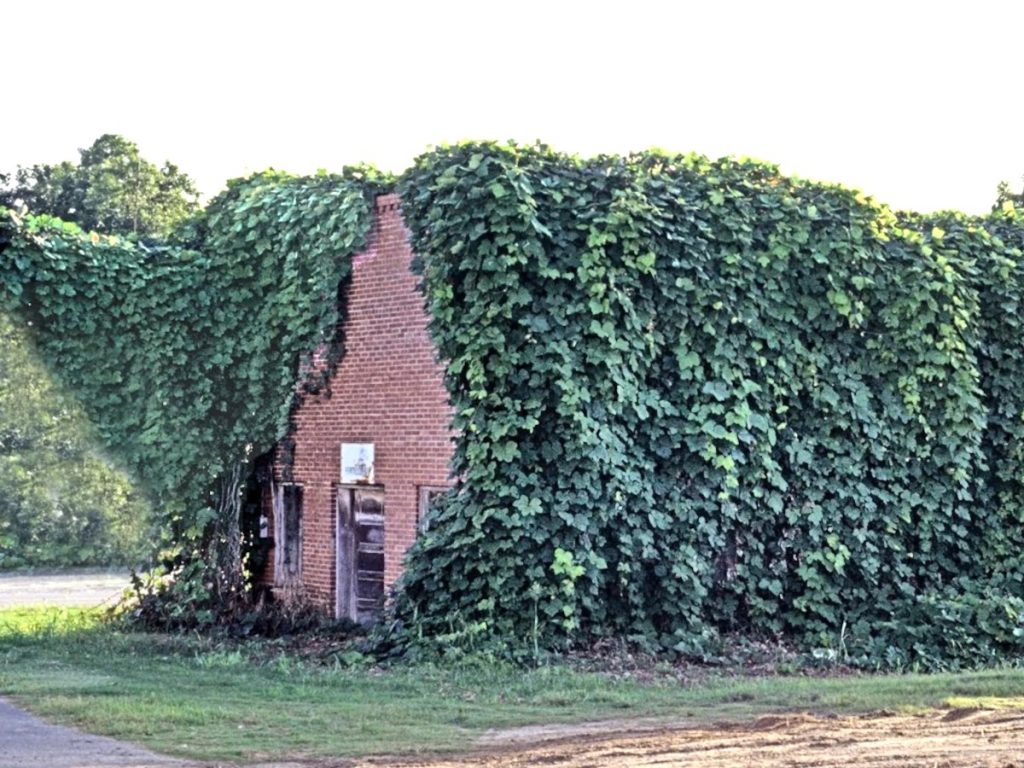
The vine spreads outward from established root crowns, roots where stems contact the ground, and climbs almost anything that provides support. Dense growth can cover shrubs, young trees, fences, utility corridors, and abandoned structures beneath a continuous blanket of foliage.
Identification and Management
Kudzu has large leaves divided into three leaflets. The leaflets may be entire or irregularly lobed, and the vines become increasingly woody as they mature. Established patches form long trailing stems across the ground and heavy climbing vines through surrounding vegetation. Purple flowers may appear in late summer, followed by flattened, hairy seed pods.
The visible foliage is only part of the plant – vines emerge from root crowns at or near the soil surface, while large tuberous roots store enough energy to produce repeated regrowth. Stems can also root where they contact the ground, allowing one patch to develop many separate crowns. Cutting the climbing vines may relieve immediate pressure on trees, but eradication requires locating and killing every crown. Established patches typically require repeated treatment and monitoring over several growing seasons.
Property Notes
English Ivy
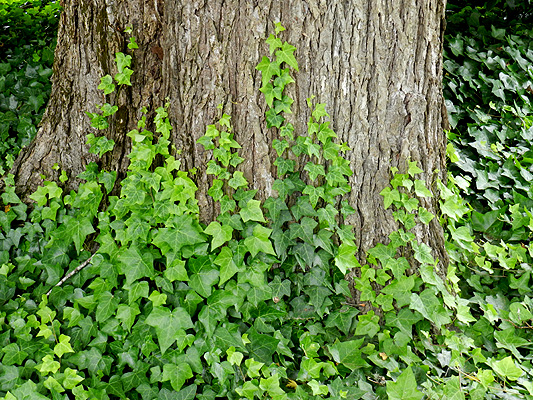
English ivy was planted for decades as a dependable evergreen groundcover, particularly beneath trees, along foundations, and in shaded areas where turfgrass struggled. It tolerates drought, grows with little routine care, and spreads quickly across bare ground.
Those same qualities allow it to move beyond the intended bed. Ivy forms dense mats across the soil, climbs trees and structures, and can persist beneath established landscapes for years before the extent of the infestation becomes obvious.
Identification and Management
English ivy is an evergreen vine with leathery leaves and pale veins. Juvenile growth usually has three to five pointed lobes and creeps across the ground or climbs using small aerial rootlets. Older climbing vines may develop thicker woody stems and unlobed leaves, particularly when they reach brighter conditions higher in a tree canopy.
Groundcover infestations can be pulled or dug when the soil is moist, provided the rooted stems are removed rather than merely broken at the surface. Vines climbing trees should be cut near ground level to separate the canopy growth from the roots. The upper vines can be left to die in place rather than pulled from limbs or bark. Established patches require continued monitoring because rooted fragments and missed stems can produce new growth.
Property Notes
Japanese Honeysuckle
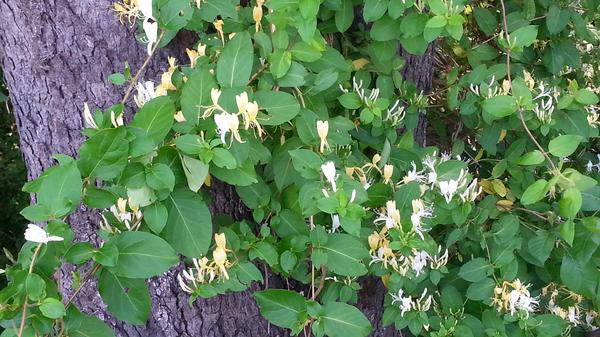
Japanese honeysuckle was widely planted because it grows quickly, remains semi-evergreen through much of the year, and produces highly fragrant white flowers that fade to yellow. It was commonly recommended for fences, banks, and naturalized landscapes before its invasive behavior became widely understood.
Today it has escaped cultivation throughout South Carolina. Long trailing vines spread across woodland edges, climb shrubs and young trees, and create dense mats that suppress native vegetation. Even where older plantings appear contained, birds readily carry the berries into nearby natural areas.
Identification and Management
Japanese honeysuckle is a twining vine with opposite leaves and fragrant tubular flowers that open white before turning yellow. Young stems are green and flexible, while older vines become woody and develop peeling bark. Unlike many native honeysuckles, the upper leaves remain separate rather than joining around the stem.
Small infestations can often be removed by digging the roots or repeatedly cutting new growth before it matures. Established patches usually contain numerous rooted stems and seedlings produced by birds dispersing the fruit. Long-term control depends on continued monitoring and follow-up rather than a single removal effort.
Property Notes
Shrubs
Privets
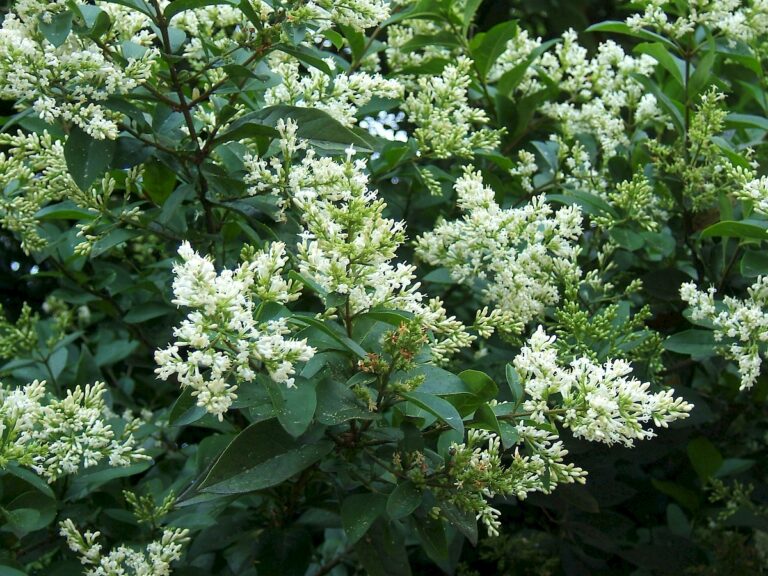
Privet was one of the defining landscape shrubs of the twentieth century. It grew quickly, tolerated heavy pruning, produced dense evergreen screening, and survived neglect better than many ornamental hedges. It was planted around homes, commercial buildings, farms, and property lines throughout South Carolina.
Those same qualities allowed it to escape cultivation. Birds readily spread the abundant berries into woodlands, drainage corridors, and vacant land, where dense thickets now crowd out native shrubs and prevent natural forest regeneration. Many homeowners inherit mature privet without realizing it is one of the state’s most widespread invasive shrubs.
Identification and Management
Privets are mostly evergreen shrubs in the Lowcountry, with opposite leaves, smooth gray stems, clusters of white flowers in spring, and abundant dark berries later in the season. Older shrubs commonly produce numerous stems from the base and spread outward into dense colonies.
Young seedlings can usually be removed by hand when the soil is moist, but established shrubs rapidly resprout after cutting unless the root system is killed. Large infestations often include hundreds of seedlings beneath mature plants because birds continuously introduce new seed. Successful management usually requires removing mature shrubs first, then monitoring for several seasons as dormant seed continues to germinate.
Property Notes
Autumn Olive
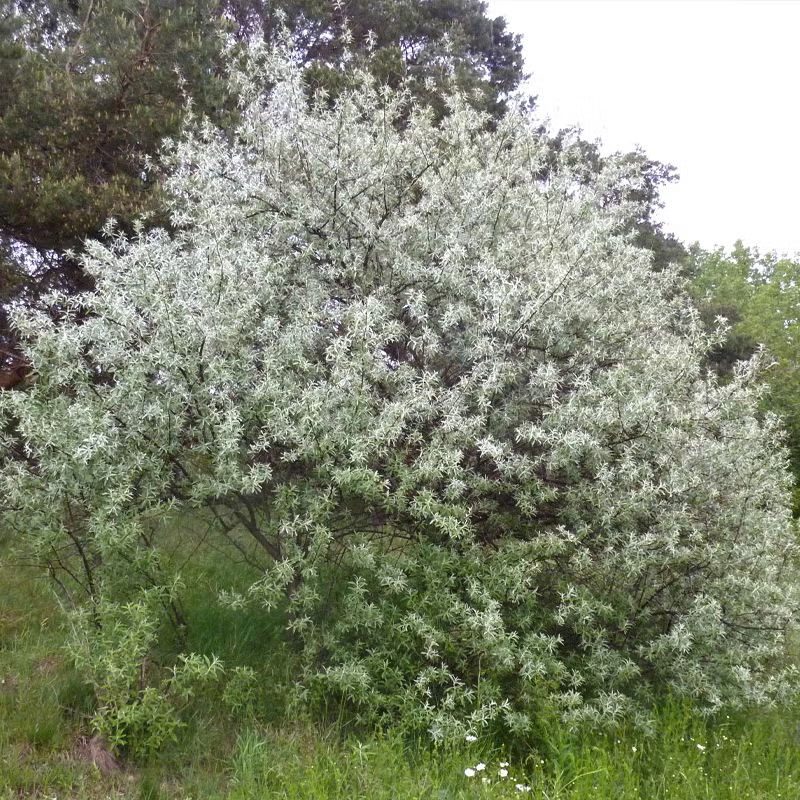
Autumn olive was introduced from eastern Asia and widely planted throughout the twentieth century to stabilize disturbed soils, provide wildlife cover, and produce fruit for birds. It grows rapidly, tolerates poor soils, and can improve its own growing conditions by fixing atmospheric nitrogen, allowing it to thrive where many native shrubs struggle.
Those same characteristics allow it to spread well beyond the original planting. Birds readily disperse the abundant red berries into fields, woodland edges, utility corridors, and roadsides, where dense stands gradually replace native shrubs and alter the character of open habitats.
For homeowners, autumn olive is often less a landscape shrub than an indicator that open portions of a property are gradually transitioning into unmanaged thicket.
Identification and Management
Autumn olive is a large deciduous shrub with arching branches and distinctive silvery scales that give the undersides of its leaves a pale, almost metallic appearance. Small, fragrant cream-colored flowers appear in spring, followed by abundant red berries speckled with silver. Older shrubs often develop into broad, dense thickets with numerous stems arising from the base.
Young seedlings are usually manageable when removed before they become established. Mature shrubs readily resprout after cutting, and birds continue introducing new seed into recently cleared areas. Because the plant fixes nitrogen in the soil, it can gradually change growing conditions in ways that favor additional invasive species over many native plants.
Property Notes
Nandina
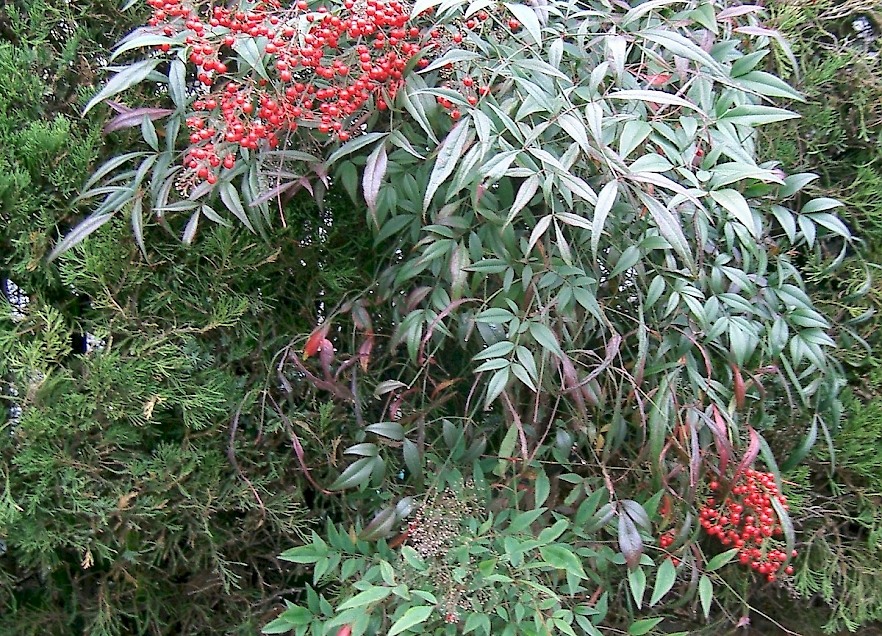
Nandina became a familiar part of Southern landscaping because it tolerates heat, drought, shade, poor soil, and substantial neglect. Its evergreen foliage, red winter color, and clusters of bright berries made it a dependable choice for foundations, parking lots, commercial landscapes, and nearly any planting bed expected to survive without much attention.
The plant is not actually a bamboo, but it can behave with similar persistence. Fruiting plants spread by seed when birds carry the berries beyond cultivated beds, while established shrubs gradually expand through underground stems. Nandina now appears in woodlands and other natural areas throughout South Carolina, often well beyond any visible original planting.
Identification and Management
Nandina is an evergreen or semi-evergreen shrub with upright, cane-like stems and finely divided compound leaves. New foliage may emerge reddish or bronze, mature to green, and develop stronger red or purple color in colder weather. White flowers appear in branching clusters, followed on many cultivars by persistent red berries.
Small plants can be dug out, but the entire crown and as much of the root system as practical should be removed. Mature clumps may contain numerous closely spaced stems and can resprout after being cut. Seedlings should also be checked for beneath nearby trees, shrubs, fences, and woodland edges, where birds commonly deposit the fruit.
Property Notes
Trees
Bradford / Callery Pear
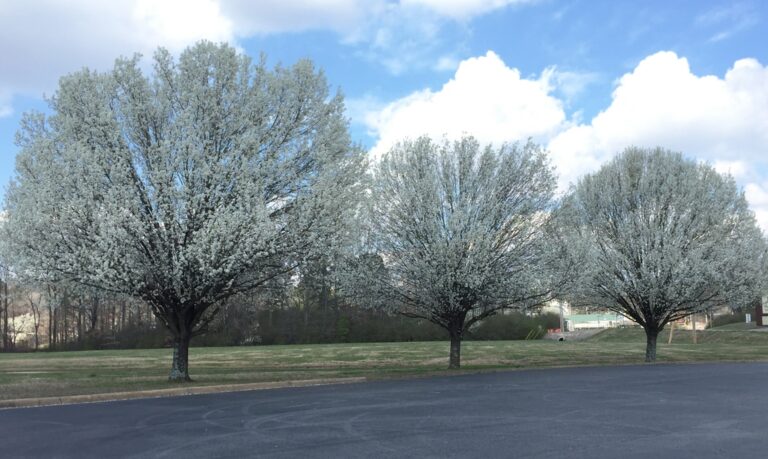
Bradford pear became one of the most familiar ornamental trees in South Carolina because it grew quickly, flowered heavily, produced dependable fall color, and arrived from the nursery with an unusually tidy shape. For several decades, subdivisions, commercial landscapes, parking lots, and front yards were planted with them by the thousands.
The arrangement eventually unraveled. A Bradford pear tree has weak branch structure and commonly splits during storms, but its larger legacy is reproductive. As additional Callery pear cultivars entered the landscape, formerly isolated ornamental trees began cross-pollinating and producing viable fruit. Birds then carried the seed into fields, roadsides, rights-of-way, and disturbed land, where thorny wild Callery pears now form dense stands.
Identification and Management
Bradford and other ornamental Callery pears are medium-sized deciduous trees with glossy rounded leaves, dense white spring flowers, and orange-red to purple fall color. Mature landscape trees often develop several large upright limbs from a narrow central union, producing the compact shape that made them popular and the structural weakness that makes them prone to splitting.
Wild Callery pears are usually less orderly. They can develop dense branching, vigorous basal sprouts, and long thorns capable of injuring people, livestock, and tires. Small rounded fruit is eaten by birds and dispersed into open ground, where seedlings grow rapidly and may begin producing fruit within only a few years.
Removal should account for both the canopy and the root system. Cut trees readily resprout from the stump and large surface roots, so the stump generally requires immediate treatment or continued suppression. If there is a mature Bradford pear tree on your property, it should be removed as soon as possible – this is a Frankenstein plant that may be more destructive than even Kudzu.
Property Notes
Remove a Bradford Pear Tree – replace it with something better,
South Carolina has gone beyond merely discouraging Bradford pears. Clemson Extension and the South Carolina Forestry Commission operate the Bradford Pear Bounty, which allows property owners to exchange removed Bradford pears for free native replacement trees at scheduled events.
Participants may receive up to five replacement trees on a one-for-one basis. Advance registration is required, the property owner is responsible for removal, and proof of the cut tree must be brought to the event. The program does not pay for removal or send a crew to perform it – the “bounty” is a young native tree, not a mysterious envelope of cash.
South Carolina no longer permits the sale of Callery pear cultivars. The prohibition took effect October 1, 2024. It does not require homeowners to remove trees already growing on private property.
Chinese Tallow / Popcorn Tree
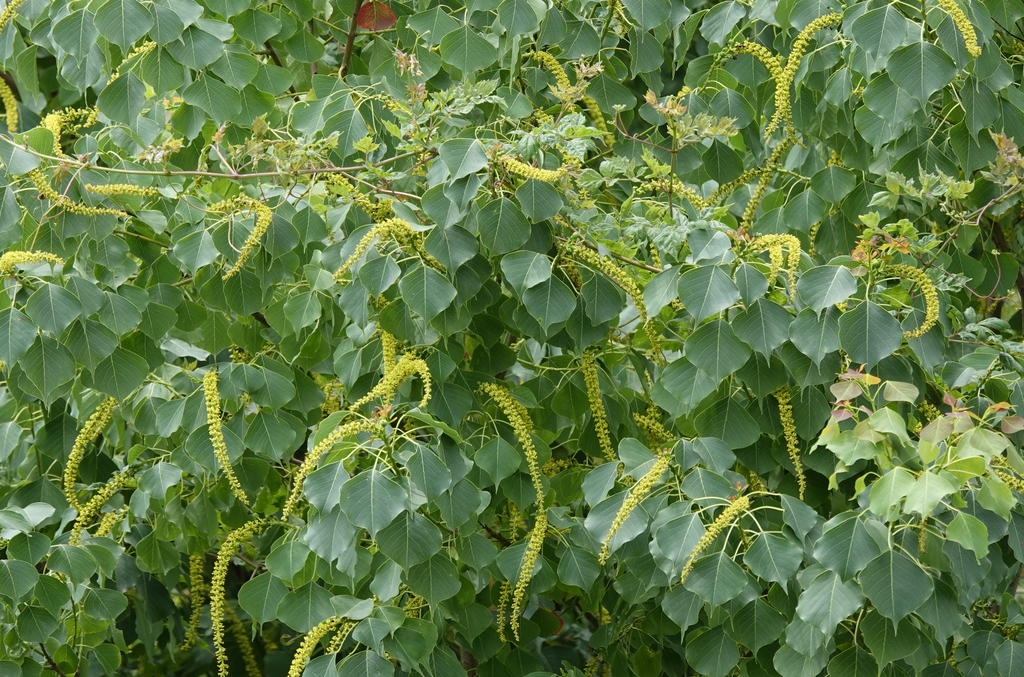
Chinese tallow was introduced from Asia and planted across the South as an ornamental tree and as a potential source of oils from its waxy seeds. It grew quickly, tolerated wet and disturbed soils, produced vivid autumn color, and supplied clusters of white seeds that gave it the familiar name “popcorn tree.”
It also proved exceptionally capable of leaving the landscape where it was planted. Birds and moving water spread the seeds into wetlands, drainage corridors, vacant parcels, roadsides, pond margins, and recently disturbed ground. Once established, Chinese tallow can produce dense stands that replace native trees, shrubs, and wetland vegetation with remarkable efficiency.
Identification and Management
Chinese tallow is a small to medium-sized deciduous tree with smooth-edged, broadly diamond-shaped or heart-shaped leaves that taper to a narrow point. Long flower spikes appear in spring, and three-lobed capsules mature later in the year. When the capsules split, they expose white, wax-coated seeds that can remain conspicuous on the branches after the leaves have fallen.
The foliage may turn yellow, orange, red, or purple in autumn, which helped make the tree popular as an ornamental. Seedlings grow rapidly in open sun but can also establish beneath a partial canopy, particularly where soil disturbance, flooding, storms, clearing, or construction have opened the site.
Small seedlings can be pulled or dug while the soil is moist, provided the root is removed. Larger trees readily resprout from the stump and roots after cutting, so removal generally requires an appropriate follow-up treatment or repeated suppression. Mature stands often contain several generations of seedlings and should be approached as a site-management problem rather than a collection of individual trees.
Property Notes
Grasses & Groundcovers
Cogongrass
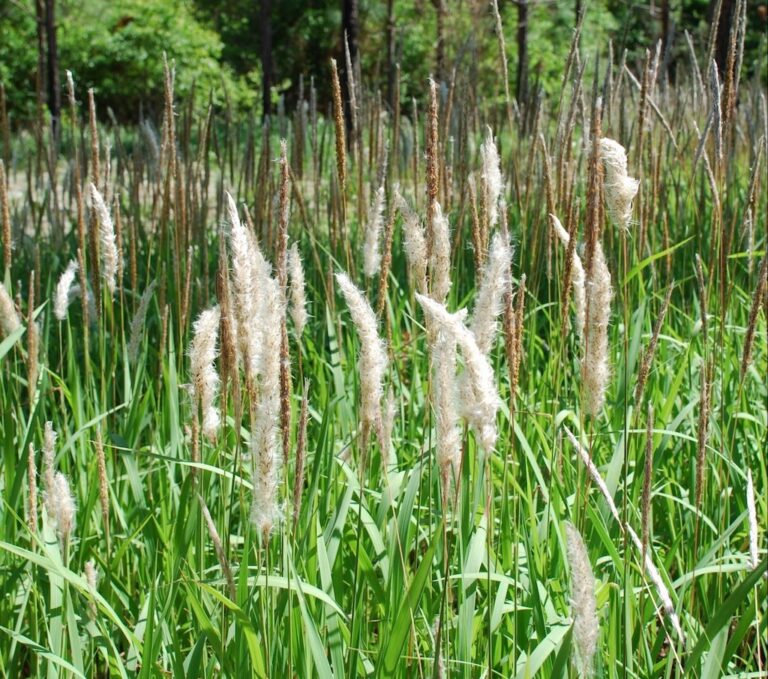
Cogongrass was introduced from Asia in the early twentieth century and eventually spread through portions of the Southeast by contaminated fill, roadside maintenance, logging equipment, and ornamental plantings. Although it resembles an ordinary ornamental grass at first glance, it is considered one of the world’s most invasive plants because of its ability to rapidly dominate disturbed ground.
Unlike many invasive plants that spread primarily by seed, cogongrass expands through an extensive underground network of sharp white rhizomes. Those rhizomes produce dense colonies that crowd out native vegetation, increase wildfire intensity, and become progressively more difficult to remove as they expand. Early detection is far easier than long-term control.
Identification and Management
Cogongrass forms dense upright clumps with narrow leaves typically one-half to one inch wide. The leaves have an unusually off-center white midrib, finely serrated edges, and pointed tips. In spring, mature plants often produce distinctive silky white seed heads that resemble soft bottle brushes.
The plant spreads primarily through tough underground rhizomes that can extend well beyond the visible leaves. Small fragments left in the soil are capable of producing new plants, making simple tilling or mowing ineffective. New infestations should be identified and addressed quickly before extensive rhizome networks become established.
Large infestations generally require a coordinated management plan using repeated treatment over multiple growing seasons. Equipment used within infestations should also be cleaned before moving elsewhere to avoid transporting rhizome fragments to new locations.
Property Notes
Running Bamboo
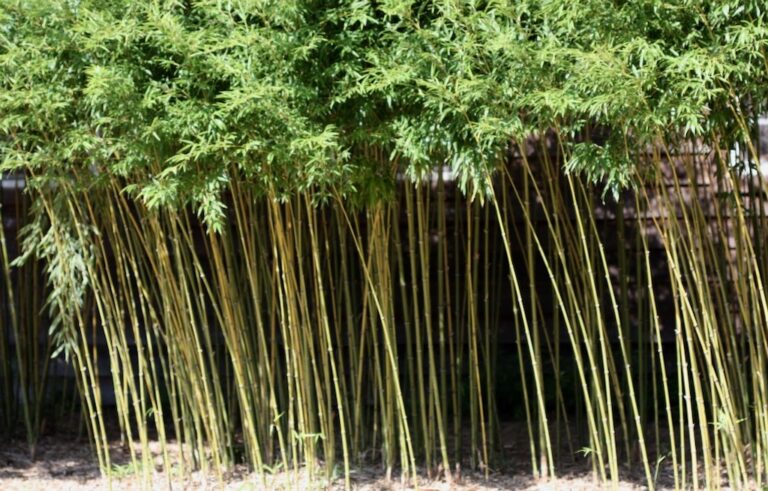
Running bamboo was introduced as an ornamental screening plant because it grows quickly, remains evergreen, and creates exceptional privacy. For decades it was planted around property lines, gardens, and suburban neighborhoods throughout South Carolina. Many of those original plantings still exist today.
The problem lies underground. Running bamboo spreads through vigorous rhizomes that travel well beyond the visible canes, often crossing beneath fences, sidewalks, driveways, and property lines before emerging some distance away. What begins as a privacy screen can gradually become a neighborhood problem, making bamboo one of the most common sources of landscape disputes between adjoining property owners.
Identification and Management
Running bamboo produces hollow segmented canes from an extensive underground rhizome system. New shoots emerge rapidly during spring and early summer, while mature groves create dense evergreen shade that suppresses many other plants beneath them. Unlike clumping bamboo, which expands slowly from the original crown, running bamboo continuously extends underground before sending up new canes well beyond the parent planting.
Successful management depends on controlling the rhizomes rather than simply cutting the visible canes. Mowing removes only the above-ground growth, while the underground network continues expanding. Effective long-term control often requires excavation, rhizome barriers, repeated cutting of new shoots, or a combination of methods carried out over multiple growing seasons.
Before removing bamboo near property lines, determine whether the grove extends onto neighboring land. Management is considerably more successful when adjoining property owners cooperate rather than treating only one side of the infestation.
Property Notes
One Grove Can Become Two Yards' Problem
Running bamboo rarely respects survey lines. By the time new shoots appear in a neighboring yard, the rhizomes may already extend well beneath fences, sidewalks, or planting beds. Homebuyers should inspect the edges of bamboo groves rather than judging the plant only by the visible canes.
If bamboo crosses a property line, discuss the issue with adjacent owners before beginning removal. Treating only one side of an established grove often produces disappointing results because the remaining rhizomes continue sending new growth into the cleared area.
Japanese Stiltgrass
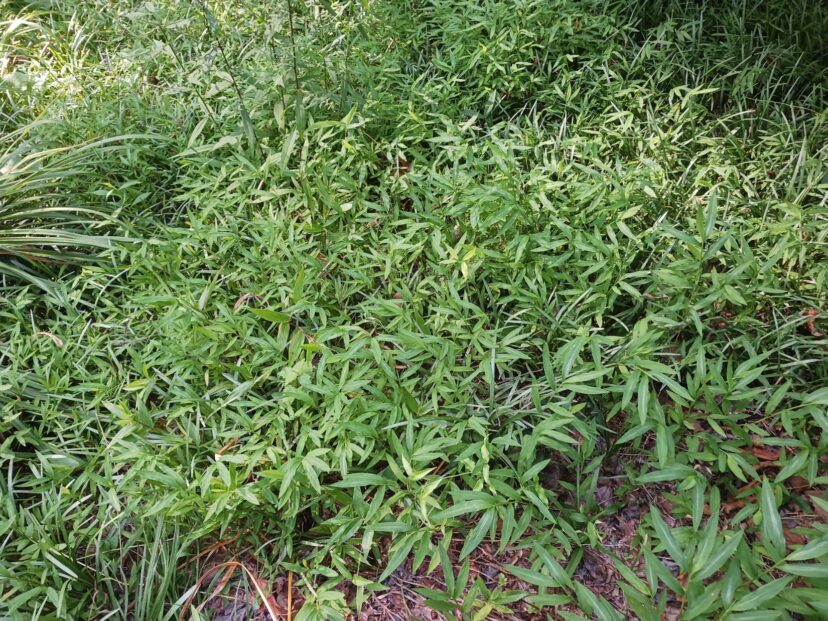
Japanese stiltgrass arrived in the United States in the early twentieth century and has since spread through forests, parks, stream corridors, roadsides, and shaded landscapes across much of the eastern United States. Unlike many invasive grasses that prefer full sun, stiltgrass thrives beneath a woodland canopy where it quietly replaces native groundcover.
The plant completes its entire life cycle in a single growing season, but each year’s growth produces abundant seed that can remain viable in the soil for several years. As new generations emerge, thin patches gradually become dense carpets that suppress native wildflowers, tree seedlings, and other woodland vegetation.
Identification and Management
Japanese stiltgrass forms loose colonies of delicate light-green stems that often lean or sprawl across the ground. The narrow leaves display a distinctive silvery stripe running along the center of the upper surface, making the plant easier to recognize once it is learned. By late summer, the grass produces numerous small seed heads before dying with the first hard frost.
Although individual plants are shallow-rooted and relatively easy to pull, the challenge lies in the enormous quantity of seed they produce. Disturbed soil, flooding, wildlife, footwear, mowing equipment, and vehicles all contribute to spreading seed into new locations. Preventing seed production is often more important than removing every visible plant during the first season.
Wooded lots should be monitored annually, particularly along trails, drainage corridors, and recently disturbed areas where new colonies commonly become established before expanding deeper into the forest understory.
Property Notes
Aquatic Plants
Hydrilla
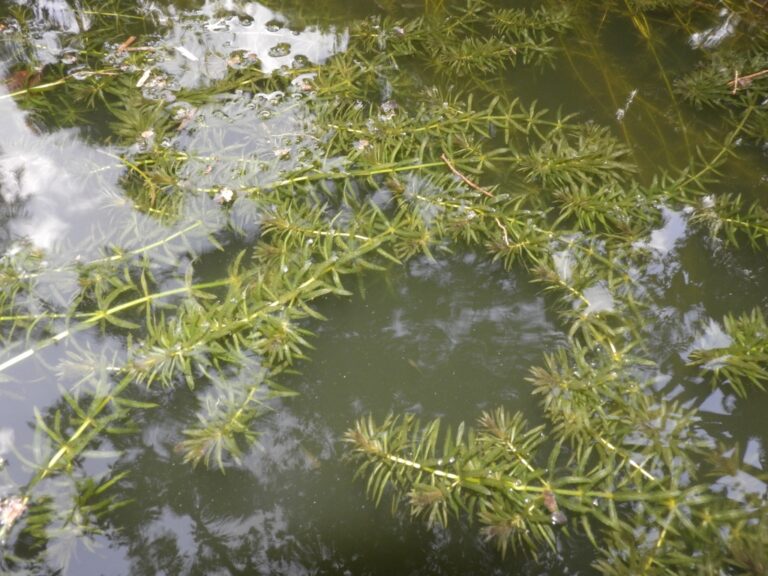
Hydrilla is a fully submerged aquatic plant introduced through the aquarium and water garden trade. It grows entirely beneath the water’s surface, where long branching stems can extend many feet before reaching sunlight and forming dense floating mats. Those mats often become the first visible sign that a pond or waterway has already been heavily colonized.
Once established, hydrilla spreads aggressively through stem fragments, underground tubers, and overwintering buds. Boats, trailers, fishing equipment, waterfowl, and moving water all contribute to its spread between lakes, rivers, ponds, and reservoirs. Because even small fragments can establish new colonies, routine recreational activities may unintentionally transport the plant from one body of water to another.
Identification and Management
Hydrilla produces slender branching stems with narrow leaves arranged in whorls around the stem, usually three to eight leaves at each node. The leaf margins are noticeably serrated, giving them a rough texture when drawn between the fingers. Beneath the sediment, the plant develops small potato-like tubers that allow it to survive control efforts and quickly regenerate after disturbance.
Mechanical harvesting often provides only temporary relief because broken stem fragments readily produce new plants. Successful management usually combines carefully timed herbicide applications with long-term monitoring, particularly in ponds and lakes where hydrilla has become well established.
Property owners should avoid transporting aquatic vegetation between water bodies and thoroughly inspect boats, trailers, kayaks, paddleboards, and fishing equipment before leaving the launch area.
Property Notes
A Neighborhood Pond Isn't Just a Decorative Lake
Across the Charleston region, thousands of neighborhood ponds serve as engineered stormwater facilities. Dense aquatic vegetation can affect water movement, maintenance access, wildlife habitat, and the appearance of the community long before it becomes obvious from the shoreline.
If you’re evaluating a waterfront property, spend a few minutes looking beyond the water’s surface. Excessive floating vegetation, unusually dense submerged growth, or repeated management equipment may indicate that the pond requires ongoing invasive plant control.
Water Hyacinth
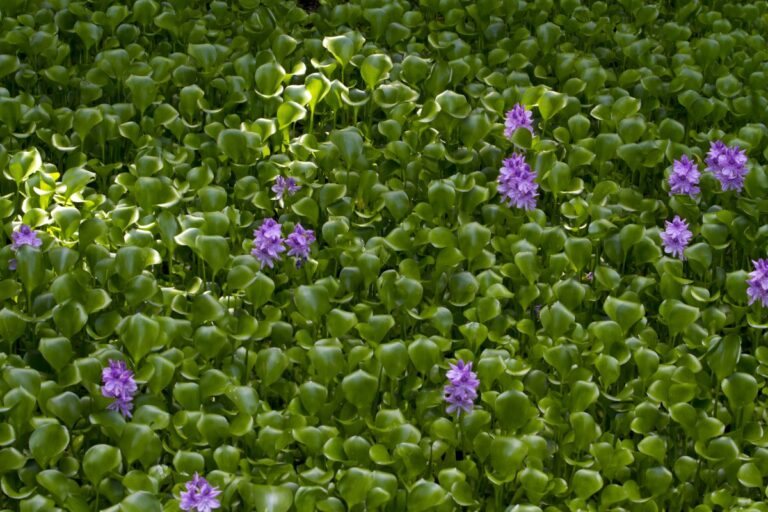
Water hyacinth is a free-floating aquatic plant native to South America and introduced widely as a water-garden ornamental. Its glossy leaves, inflated leaf stalks, and showy lavender flowers make it unusually attractive for a plant capable of rendering an entire pond nearly unusable.
Because the plants float freely rather than root into the pond bottom, wind and water can move them rapidly across a waterbody. New plants form along short connecting runners, allowing a few rosettes to become a dense interlocking mat that blocks sunlight, restricts water movement, and crowds out native aquatic vegetation.
Identification and Management
Water hyacinth grows as a floating rosette of thick, glossy, broadly oval leaves. The leaf stalks are spongy and often swollen, helping the plant remain buoyant. Long dark roots hang freely beneath the rosette, while upright flower spikes produce conspicuous lavender to purple blooms, often with a yellow marking on the upper petal.
The plants reproduce rapidly by producing daughter rosettes along short runners. Individual clusters can drift with wind and currents, collect around shorelines and outlet structures, and merge into dense mats. Those mats may reduce light penetration and oxygen exchange while interfering with drainage, boating, fishing, and pond maintenance.
Small infestations may sometimes be removed by hand or mechanical harvesting, provided every plant is collected and disposed of away from the water. Larger infestations usually require coordinated professional management. In community stormwater ponds, residents and association boards should not improvise aquatic herbicide treatments; Clemson recommends using a properly licensed aquatic applicator.
Property Notes
Do Not Buy, Share, or Relocate This Plant
Water hyacinth is listed as an illegal aquatic plant in South Carolina. It should not be purchased for a water garden, given to another property owner, or moved from one pond to another.
South Carolina Resources
Invasive Plant Species
Invasive Species
Plant Identification and Control
Aquatic Plants and Weed Control
A Home Includes the Landscape
I advise clients on what deserves closer investigation, what may require professional evaluation, and what could become a worthwhile improvement rather than an unpleasant surprise. That includes invasive growth, stormwater movement, hardscape and grading, the condition of established plantings, and ways native plants can be protected or better integrated into the property.
My interest in this work began well before real estate, while cataloging native plants in South Carolina during my university years. I am not a substitute for an arborist, landscape architect, or horticultural specialist, but I know enough to recognize when the landscape is telling us something important – and when the right expert should be brought in.
During Home Tours
Water and Hardscape
Native Plant Opportunities
After Closing
A practical landscape assessment after closing